
Interviewer: Thanks for coming. How can I refer to you?
Deriv’era: Thanks for organizing this. Call me Deriv’era.
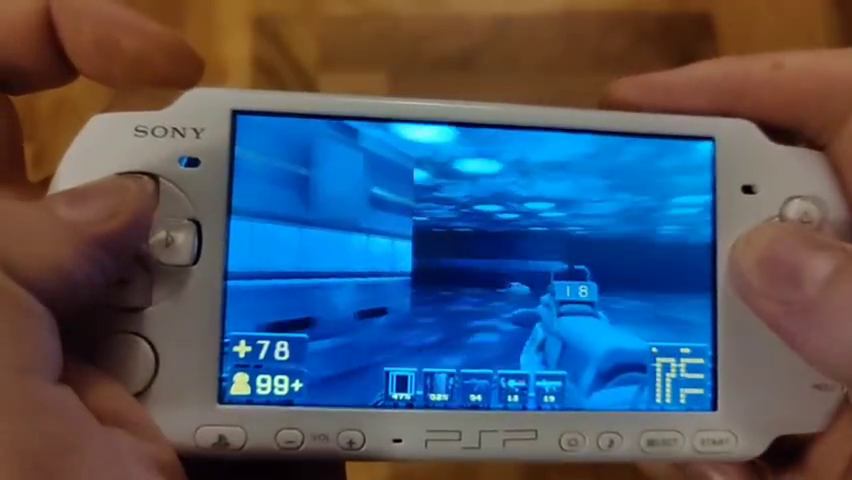
Interviewer: You created a PSP game in 2025. Why? Why PSP?
Deriv’era: My thought process was straightforward – to create something small you need to pick platform that will restrict your crazy ideas to something realistic. I initially planned to make Locum Tenens in just 2 months. But it turned out to be almost a year. Imagine how long it would be for me to make a full PC game. PSP just met my hardware desires out of all options.
Interviewer: Did the fact that game is made for PSP affected sales?
Deriv’era: Yes, but not as much as I wished. There are definitely a community around PSP. But it’s not that big.
Interviewer: What was the hardest part?
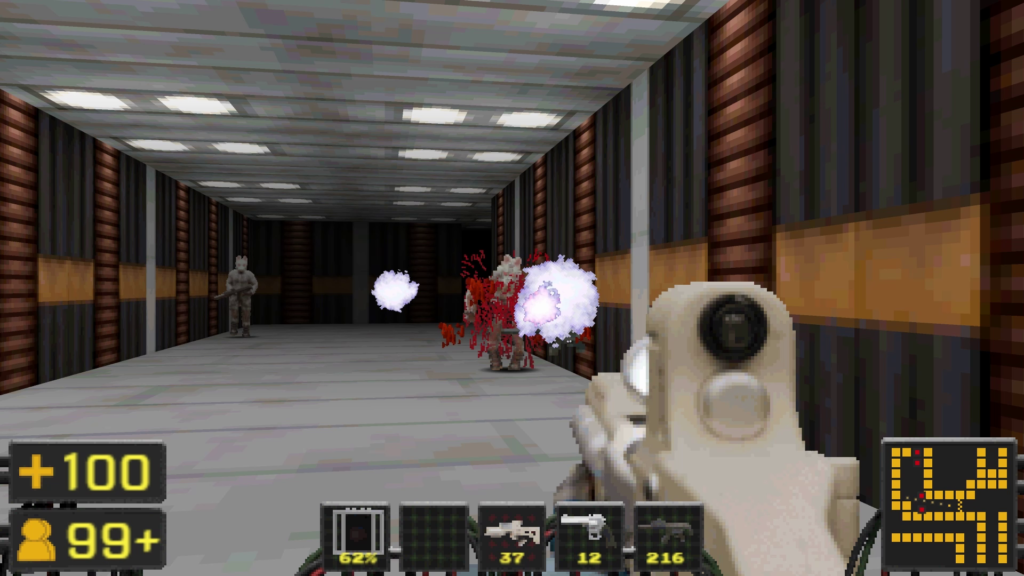
Deriv’era: Definitely GPU. In first person games level rendering always has been the biggest problem because levels are massive and the have very uneven structure, doors and other stuff. I rewrote this part of my game’s engine many times, around six or seven. Because of the balance of performance and the need to solve GPU issues with low calculation precision.
Interviewer: We touched this topic before, but, can you elaborate more?
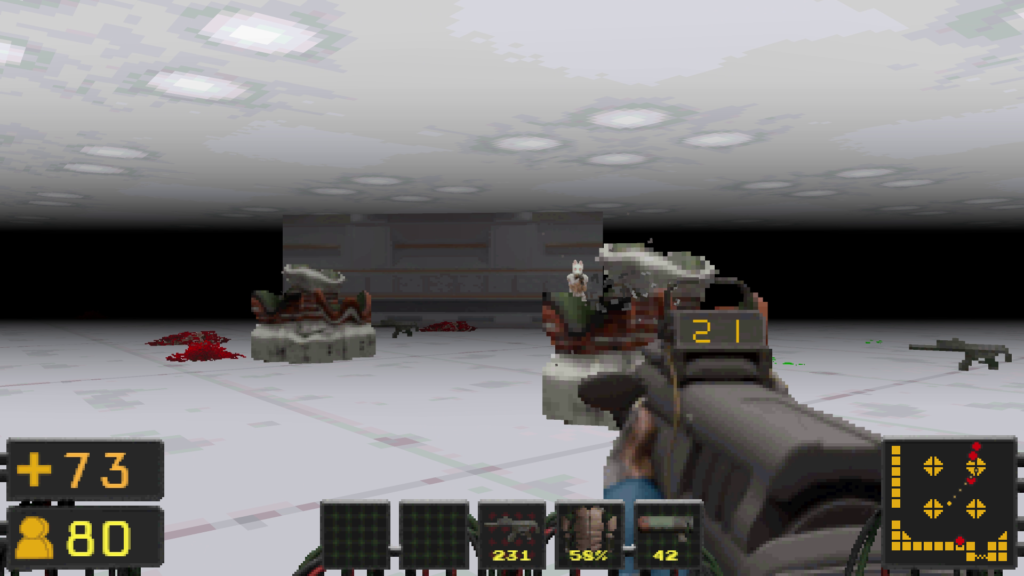
Deriv’era: Sure. You position objects in 3d through matrix transformations. It’s basically 16 numbers that represent rotation, scale and position in a specific mathematical manner. So if you have a corridor that connects to another corridor you can make it in two ways. First, If they are the same – you hold one geometry for both in the memory and then clone them around. These clones will have different transformation matrices that will give them different positions. Modern GPUs are very precise and vertices of polygons will be in the places where they need to be. Or where you expect them to be. Vertex is basically just a vector. So, to calculate each Vertex position in the scene GPU takes transformation matrix and multiplies it with these vertices. And that’s where PSPs GPU devil is. It cuts some costs on how precise this calculation is. So two corridors with different transformation matrices will be slightly shifted from the positions where they are intended to be. This gives you ability sometimes to see between polygons.
Interviewer: How about the community? If something doesn’t work do you have people to ask?
Deriv’era: I’m personally a loner so I don’t ask people much. But you definitely can find discord channels and forums where are people who can help. I think you can ask PSP SDK developers directly as well. They probably would be pleased if you do so.
Interviewer: So you learned and did everything by yourself?
Deriv’era: Correct.
Interviewer: What would you change in your process if you started working on Locum Tenens now?
Deriv’era: First of all I would think of the game as Steam first release rather than PSP first and then PC port. It doesn’t matter how I love making stuff for PSP, I would prefer just more people playing my game. And I think in this case PC is more important platform. That’s the only change I would make honestly. Realistically I also shouldn’t make first person shooter as my first PSP game because it’s a difficult task on an unknown hardware. But I would repeat this mistake again if I could.
Interviewer: Why FPSs are hard to create for PSP?
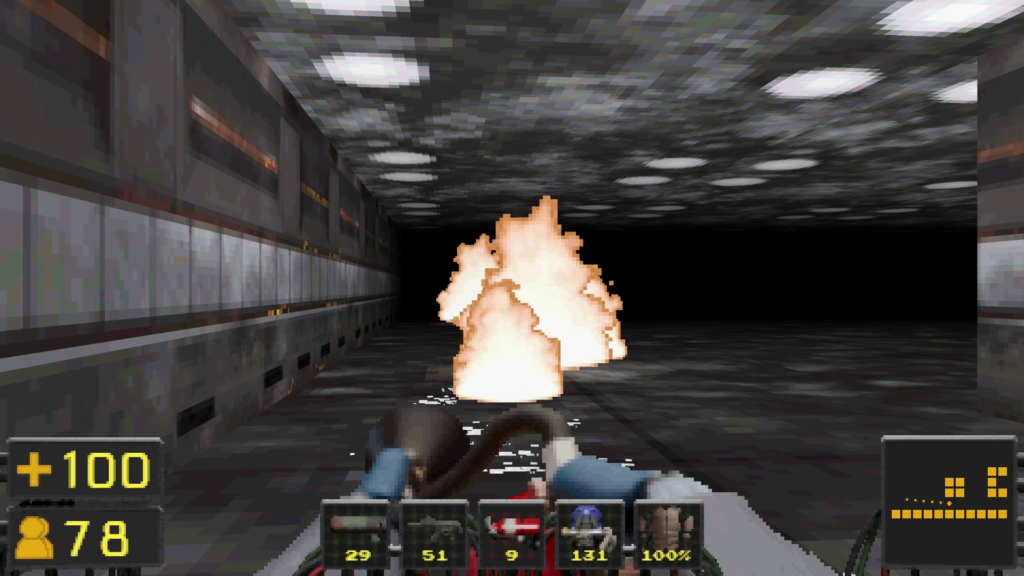
Deriv’era: PSP draws polygons pretty fast. And it can do massive levels technically. But as I said you need to organize your levels for PSP to avoid visual artifacts. Also what blocks you from just splitting levels on chunks is how culling of polygons works on PSP. Culling is what prevents polygons to be drawn if they are outside of the screen. If they are crossed by the screen border culling algorithm breaks polygon down on parts that are visible. PSP’s culling, at least the default one, very low precision and removes polygons that are visible. To fix this I divide polygons close to the camera onto smaller polygons. Similar to how perspective correction worked on PS1 in Tomb Raider. FPS genre allows you to be close to the walls with angles you really would prefer to avoid. In third person view for example you have more camera control to avoid such situations. In addition you have only two shoulder buttons. And one analogue stick so even good controls are a problem. You forced to make levels flatter just because looking up and down is difficult without two sticks or four shoulder buttons.
Interviewer: Do you plan on making another PSP game?
Deriv’era: Maybe but I don’t want to promise anything.
Interviewer: So, you’re working on something?
Deriv’era: Yes, very slowly. Currently I’m not ready to disclose it.
Interviewer: Do you have something to say to our audience?
Deriv’era: I have a hope that my example will actually inspire people to make more modern PSP games and true retro console games overall. Be creative. Create. Reject AI.
Interviewer: Thanks for coming!
Deriv’era: You’re welcome.